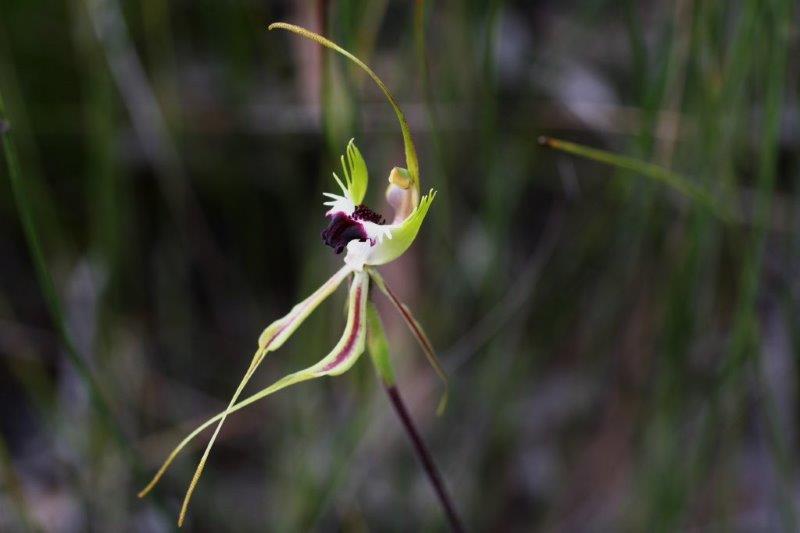
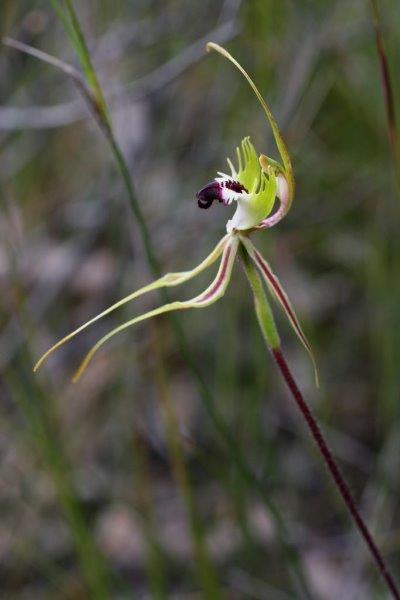
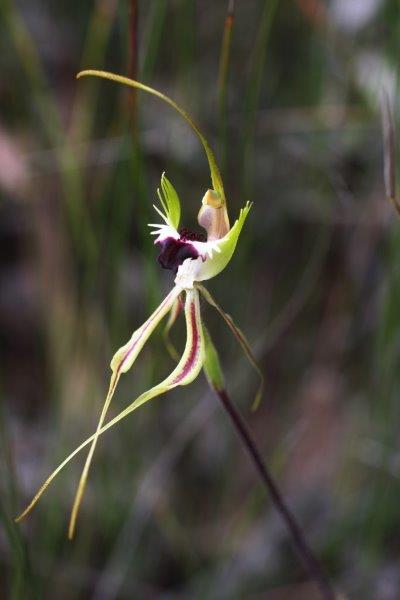
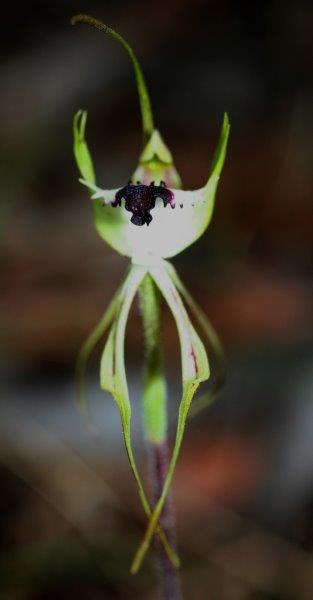
Mantis Orchid is a tuber-producing erect herb that has been observed in just a couple of locations in Coastal Moonah Woodland along the Jan Juc cliff top. It also occurs in heathland and open forest toward Anglesea.
The species name tentaculata means tendril-like; a reference to the flower's white and green comb.
Foliage is confined to a single leaf; lanceolate to 15cm long by 20mm wide, hairy both sides with red spots near leaf base.
Up to two flowers are held on a single, fine, long, hairy flower stem to 40cm tall.
Flowers can reach 10cm across with petals and sepals green with a maroon stripe. The labellum (a modified petal) is loosely hinged and features a white and green-toothed comb along each margin; white in the centre with four rows of protruding maroon-coloured calli terminating in a deep maroon tip.
Like all our terrestrial orchids Mantis Orchid survives below ground as a tuber during summer that begins growing with autumn rains, flowering in spring and then aerial parts dying down again the following summer. Whilst all our terrestrial orchids are dependent at some level on mutually beneficial soil fungi (generically known as mycorrhizal fungi), some orchids like Caladenia have a very close association with specific fungi which are critical for their survival.
Native male thynnid wasps are deceived into visiting the flower to copulate and in doing so are responsible for pollination.